
It's natural to think about wildfire preparedness as a personal project — something you do to protect your own family. But the science of wildfires tells us that individual protection has a ceiling. The most dangerous fires aren't stopped at property lines. Understanding how neighborhoods actually burn — and what it takes to stop that process — changes the math entirely.
In many of the most destructive wildfires in recent history — the 2021 Marshall Fire in Colorado, the 2018 Camp Fire in California, the 2017 Tubbs Fire in Sonoma County — the losses weren't simply from fire advancing on individual homes. They were from neighborhoods becoming fire events themselves, where burning homes ignited adjacent homes in rapid succession.
Wildfire scientists call this home-to-home, or structure-to-structure, ignition. As Fire Safe Marin's research notes, drawing on work by wildfire scientist Jack Cohen, wildfires that are most clearly remembered by the public are those where the event became an urban fire in which home-to-home spread became more significant than wildland-to-home spread — especially as the distance between homes decreases.
Even a home that has been fully hardened with ember-resistant vents and noncombustible materials faces elevated risk if the homes around it are not protected. Embers from a burning neighbor's roof travel the same paths — into unprotected gutters, through standard attic vents, under unenclosed decks — as embers from the main fire.
The implication is straightforward: a neighborhood is only as protected as its least-prepared home. Individual action matters — but community action multiplies that protection.
Wildfire Defense Mesh's Community Resilience Program was designed with this reality in mind. The program offers significantly reduced pricing when a group of households in a neighborhood participate together — making whole-street protection genuinely achievable for communities that coordinate.
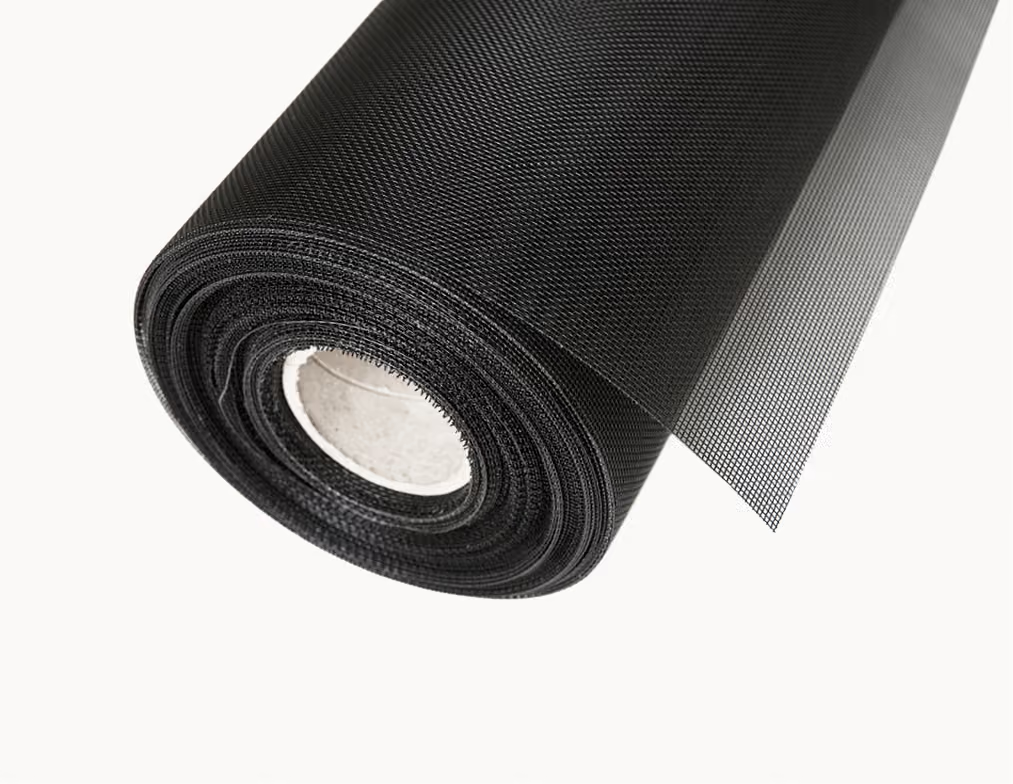
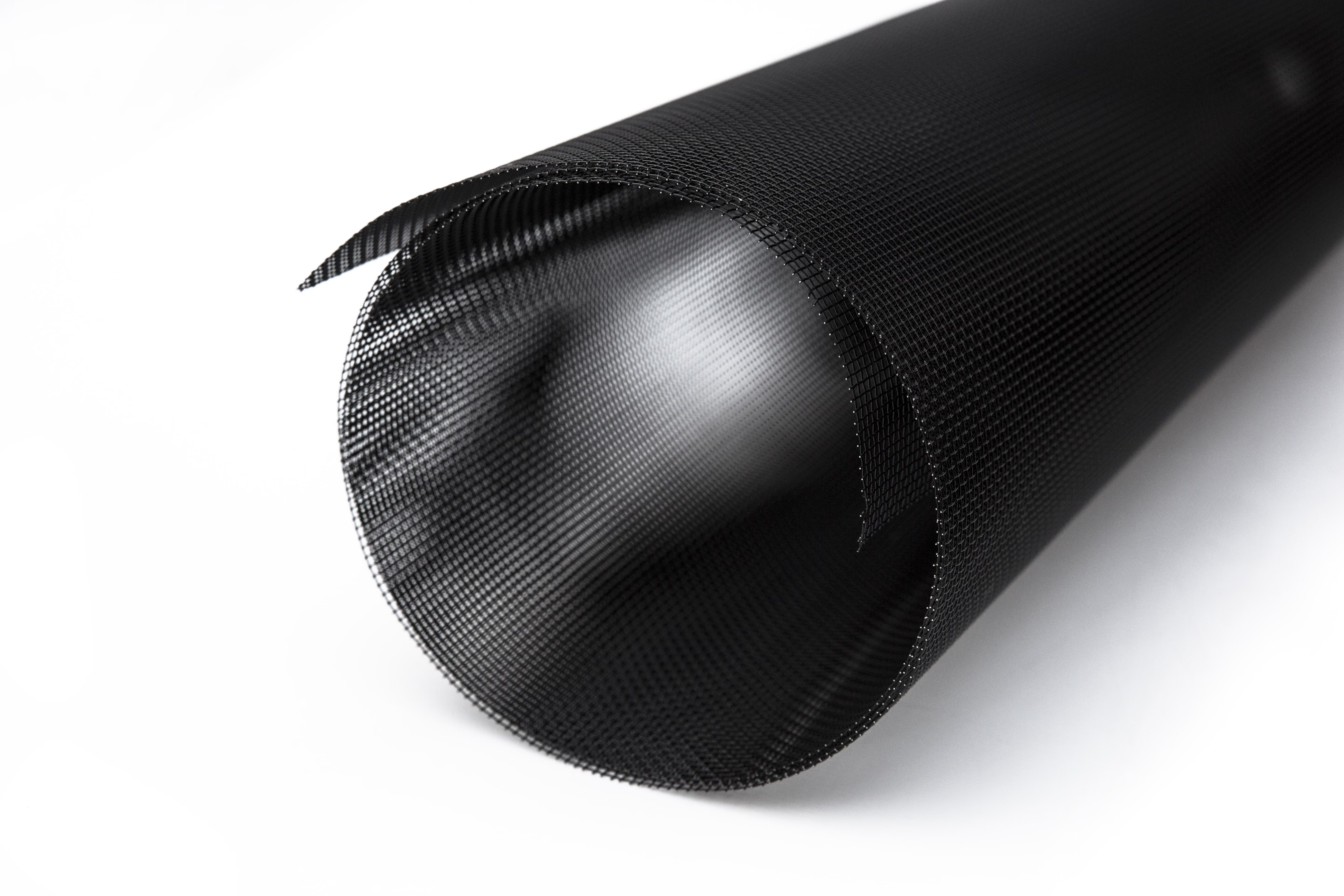
Here's why it works. A single roll of WDM mesh can cover dozens of foundation vents or gable vents. A few shared rolls can address an entire street's most critical ember entry points. The cost per home drops meaningfully as participation grows, because larger shared orders spread the material more efficiently across more households.
The program provides rolls of mesh — installation is not included, but as covered in our DIY guide, WDM is designed for straightforward self-installation requiring only basic tools. Neighborhoods that want professional installation can also access WDM's pro-installer network.
Bringing up wildfire risk with neighbors requires a balance: urgency without alarm, motivation without fear. Here are approaches that have worked well in communities across California, Colorado, and Texas:
The most effective talking point is often cost. Objections to wildfire preparation are frequently financial rather than motivational — and community pricing directly addresses that barrier. When neighbors understand that participating in a group order makes protection significantly more affordable than individual purchase, it shifts the conversation from "should we" to "how do we get started."
In the aftermath of the Marshall Fire, which burned through Boulder County, Colorado in December 2021, a group of homeowners organized a community preparedness initiative using Wildfire Defense Mesh. The fire — driven by extreme winds and carrying embers across an urban landscape — had illustrated precisely the risks that the community program is designed to address: fast-moving embers igniting perimeter fencing, decks, and unprotected vents across entire neighborhoods in minutes.
The Colorado community project became a model for how neighborhoods can organize collective action: identifying block captains, coordinating a single group order, and scheduling a shared installation weekend. Community pricing brought the cost per household well below what individual orders would have required, and the visual impact of an entire street with protected vents and enclosed decks created social momentum that extended participation beyond the initial organizers.
Read the full Colorado community program case study on our website.
In many wildfire-prone states, home hardening grant programs can reduce — or in some cases eliminate — the cost of protective improvements. These programs are often underutilized simply because homeowners aren't aware they exist.
In California, the most significant program is the California Wildfire Mitigation Program (CWMP), a joint initiative of the California Governor's Office of Emergency Services (Cal OES) and CAL FIRE. The program provides financial assistance specifically for home hardening activities in high fire-risk communities, with priority given to low- and moderate-income households. It is funded 75 percent through FEMA's Hazard Mitigation Grant Program and 25 percent through state appropriated funds.
Beyond the state-level program, county-level initiatives exist across California. Sonoma County's SoCo Adapts program has offered rebates of up to $10,000 for wildfire-hardening upgrades using FEMA funding. The San Rafael Fire Department has provided grants up to $15,000 per parcel over a 10-year period.
FEMA's Hazard Mitigation Grant Program (HMGP) Post-Fire also provides funding in areas that have received Fire Management Assistance Grant declarations, covering ignition-resistant building materials for properties that have completed or committed to defensible space measures.
WDM works directly with homeowners and community groups to help identify and access available grant programs. Contact us before placing a community order — in some cases, grants can meaningfully offset the cost for qualifying households.
The first step is the easiest: reach out. Contact Wildfire Defense Mesh to discuss your neighborhood's needs, confirm eligibility for community pricing, and get guidance on the most effective applications for your specific homes and geography. Our teams serve the West Coast and Central/Mountain regions and can typically provide a community order estimate within 24 hours.
From there, the timeline depends on neighborhood coordination — most community orders from first contact to installation are completed within four to six weeks. Wildfire season doesn't give unlimited lead time; the conversation is always better started early.